Preliminary
The Explainer Notebook can found here or here.
This website is a product of the final assignment in the DTU course: 02806 Social Data Analysis and Visualization. The project deals with the fantasy book series “A Song of Ice and Fire” (by George RR Martin) which TV-show (Game of Thrones) has taken the world by storm. The primary dataset originates from Kaggle and consist of 38 battle/rows with 25 attributes for each. We match it with a dataset of the Game of Thrones map, which also includes information about landmark names, and which territories are claimed by who.
The primary dataset is a collection of the battles from the first part of the series (a span of the years 298-300). It contains simple information like name, year, location, but also who attacks and defends, as well as the type and outcome of the battles.
The dataset is small and incomplete, hence we will try to accommodate to our best abilities. Additionally, it has required some corrections of inaccurate values, which have also been pointed out in the Kaggle discussion forum.
It should also be made clear that we obviously can not do a typical social data analysis on the data, as the ground truth is inherently fictitious, and does not reflect anything from the real world. Despite this limitation, we will still have to imagine that it is true, and then reference the series as if it were the real world.
Introduction
The Game of Thrones world primarily takes place in the continent of Westoros, which consists of 7 once independent kingdoms:
- The North: A vast and cold region ruled by House Stark from Winterfell. It's known for its harsh winters and rugged landscapes.
- The Vale of Arryn: A mountainous region ruled by House Arryn from the Eyrie, a castle perched high in the mountains.
- The Riverlands: A fertile region marked by rivers and ruled from the castle of Riverrun. House Tully is the principal house of this area.
- The Westerlands: Rich in natural resources, particularly gold mines, and ruled by House Lannister from Casterly Rock.
- The Reach: The most fertile region of Westeros, known for its agriculture and ruled by House Tyrell from Highgarden.
- The Stormlands: A coastal region prone to storms, ruled by House Baratheon from Storm's End.
- The Crownlands: Surrounding the capital city of King's Landing, ruled directly by the ruling monarch on the Iron Throne.
Since then, they have been unified under Targaryen rule. The death of Robert Baratheon, king of the 7 kingdoms, leads to the War of the Five Kings, which is a war between those kings who find themselves to be the rightful heir of the Iron Throne. This position is currently being held by the eldest son of Robert, Joffrey Baratheon, who is also affiliated with the Lannister house from his mother’s side. As Joffrey eventually dies from poisoning, his innocent brother Tommen takes his spot as king.
This war sparks a lot of conflict. Battles are fought, trust is broken, and people will meet their demise. We will rely on data from the battles during the war to reflect this. Hopefully, this will give us enough insight to answer 3 important questions:
- How have the kings and houses interacted during the war?
- Who is most successful in battle?
- Which alliance is the most powerful one in the 7 kingdoms?
Kings, Houses and Alliances
Westoros has many great houses; but in times of war, it is imperative to find the right allies. By inspecting who attacks and defends together, we can establish an overview of which alliances have been formed:

The Starks have a strong reputation of honor, and have allied with the neighboring houses Blackwood, Darry, Tully, and Frey, led by Robb Stark - “King of the North”. We see that the Freys have both attacked for the Starks, and against them. They betrayed the Starks during a wedding, in favor of Joffrey Baratheon of the Lannisters, who gladly supported the idea of an ambush. The Lannisters have also become allies with Bolton, Tyrell, Bracken and even during a single instance, the Greyjoys. Balon, and later Euron Greyjoy - “King of the Iron Islands” usually work alone. They are a proud people, who have a strong navy. They abuse the absence of Robb Stark to attack his home, Winterfell, which further complicates their relationship. The brother of the now dead Robert Baratheon, Stannis Baratheon has trouble gathering big armies and allies, and often uses dark magic, which he even uses to kill his brother Renly Baratheon very early in the war. He has also once aided the North against the primal tribes who attacked the Wall, but still has not gained their alliance.
To get an idea of the geography of the world, consider this map of Westeros, where we can inspect each Kingdom, and the battles during the war. The markers are colored wrt. the winner of the war. Other information is available upon clicking or hovering as well. Feel free to explore:
By landmass alone, it would seem obvious that the Starks should easily outnumber the other kingdoms:
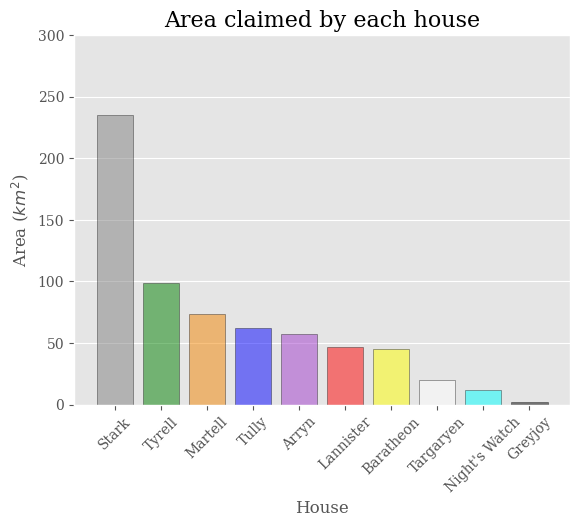
The reason for its huge area is mainly due to the cold climate. The Starks have learned to live under these conditions, and naturally rule The North as it’s called. On the other hand, we see that the Lannisters and Baratheons are practically tied wrt. area. Then we have the Greyjoys, who are situated on a single archipelago, The Iron Islands. Even with their superior navy, it would seem optimistic for them to claim the Iron Throne, given their lack of people and resources.
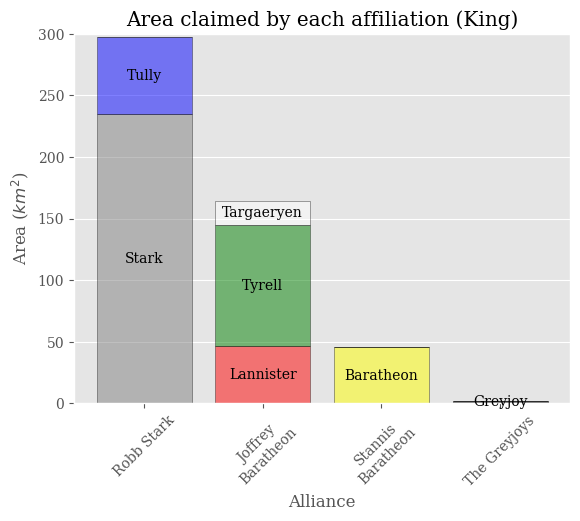
If we instead consider the joint area of each alliance (see figure above), Joffrey quickly catches up on Robb. Given that he officially is the current king of the 7 kingdoms, he has gathered the strong allies, the Tyrells. On top of that, the Iron Throne is located in the city King’s Landing on Targaryen soil, which the King automatically owns, as the Targaryens are essentially extinct. It might actually seem like Joffrey has a more effective amount of landmass, while Stannis and the Greyjoys seem even smaller now in comparison.
The Great Battles of Westeros
It is now more clear who has a winning chance in this war. Robb Stark and Joffrey Baratheon both seem to own much land, which should be equivalent to more resources and military power. Alliances have evened out the playing field for these two kings, while Stannis and the Greyjoys still seem to lack in numbers. That being said, it’s not certain that more land equals more greatness or military prowess. Instead, this should be assessed on the battlefield. Let us now have an overview of the battles throughout this war.
Wins and losses
To start out, we can observe the distribution of wins and losses among the kings:
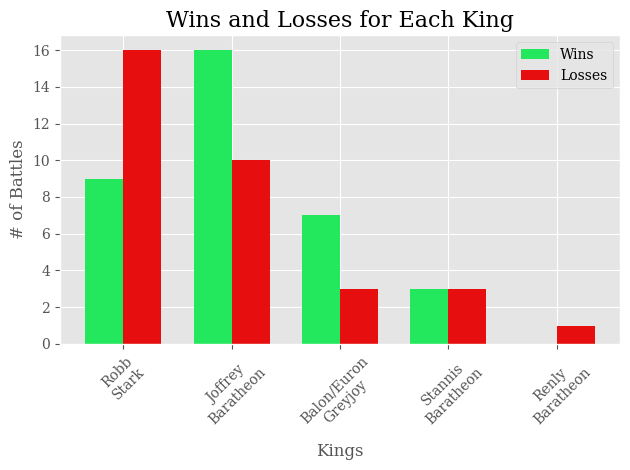
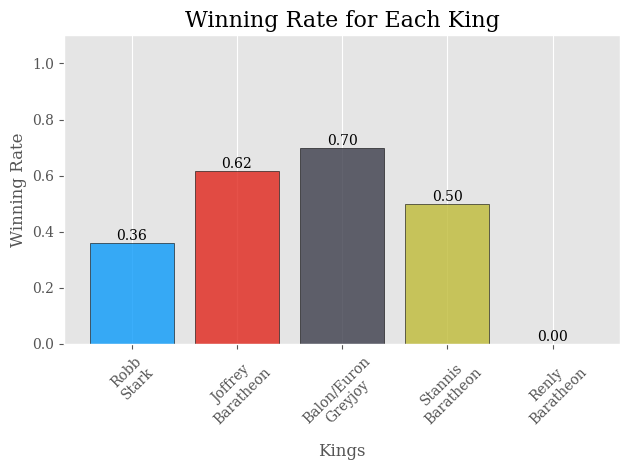
To our surprise, Robb has lost many of his battles, despite his seemingly advantageous size. Even the small Greyjoy forces have a good battle history, which must be a sign that the Greyjoys are better at picking their battles. It could also be argued that Robb’s army is more scattered, leaving the strength of the army unevenly distributed across the continent. Both Stannis and Renly don’t seem to perform so well either. They are not as good at utilizing their small forces as the Greyjoys are. It would seem that the Lannisters are superior in battle, but that the Greyjoys are also very effective. In terms of winning-rate, the Greyjoys actually exceed the Lannisters:
Battle types
There are several types of battles being fought throughout the series, namely:
- Ambush: Attacking someone by surprise
- Pitched battle: Classic battle on a battlefield
- Siege: Invading a stronghold/fortress
- Razing (or raiding):Destroying everything in ones path
We might be able to uncover some tactics from each king, by inspecting their preferred types of battle.
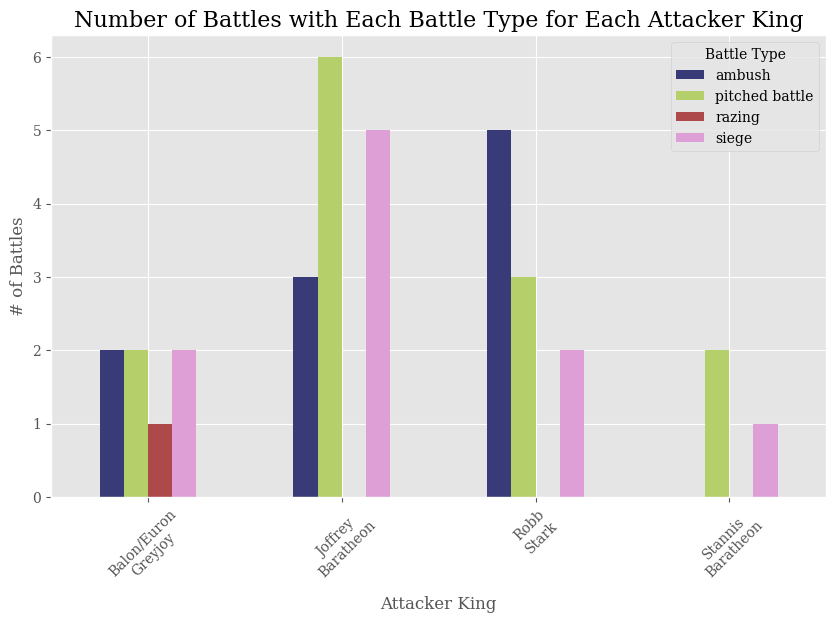
It is quickly noticeable that the Greyjoys are the only ones participating in razing. This would reflect their viking-like military style.
We see that Stannis uses pitched battles and siege. The fact that he never ambushes or razes, despite the effective outcome of those, would indicate that he values his honor too much. His use of dark magic might not be considered very honorable, and yet he has never betrayed any ally, which is considered very honorable in this otherwise untrustful world.
Joffrey utilizes a balance of ambush, pitched battle, and siege, while ambush is on the lower end. As he supposedly has the strongest army at this point, it would not make sense for him to utilize ambushes, as his army is plenty strong to handle a head-on battle.
Robb utilized ambushes a lot. This is probably the product of him always being on the offense, and not having as strong of an army as Joffrey.
These are simply summary statistics, trying to encapsulate the power balance of the war. To get a more accurate depiction of it, we present a timeline of the major battles and events, inspired by what we know from the series, as well as interpreting directly from the battle dataset. From the data, we are given only the year of the battle, and then we also assume that the order of the battles are given in chronological order. Below the written timeline, we have also provided a timeline map of the battles in the order in which they appear.
These are simply summary statistics, trying to encapsulate the power balance of the war. To get a more accurate depiction of it, we present a timeline of the major battles and events, inspired by what we know from the series, as well as interpreting directly from the battle dataset. From the data, we are given only the year of the battle, and then we also assume that the order of the battles are given chronologically. Below the written timeline, we have also provided a timeline map of the battles in the order in which they appear.
Timeline
- Year 298:
- 1-4: Robb suffers 4 consecutive defeats from Joffrey
- 5-7: Robb retaliates, and wins 2 times against Joffrey, but defeated again
- Year 299:
- 8-14: As Robb’s army is fighting in the center of Westeros, the Greyjoys swoop in and overcome most of Robb’s defenses at his home, Winterfell.
- 15: The Bolton’s claimed that they would help defend Winterfell, but actually ended up burning it to the ground - an act of betrayal.
- 16: Stannis defeats his brother Renly, claiming a large part of Renly’s cavalry, which he later utilizes to attack Joffrey
- 17-19: More fighting between Robb and Joffrey in central Westeros
- 20: Stannis has reached King’s Landing, where Joffrey comfortably sits on his throne. With the help of Joffrey’s uncle, Tyrion Lannister, he managed to keep Stannis’ army away from the city.
- 21-27: More fighting between Robb and Joffrey in central Westeros
- (26): Among these fights, the Freys betrayed Robb, getting him and his close family killed, weakening the strength of the North
- Year 300:
- 28: Stannis aids The Night’s Watch in defending Castle Black against the Free folk
- 29-31: A few smaller fights
- 32-33: Euron Greyjoy has become the new king of the Iron Islands, and wanted to capture several islands as part of his conquest for taking over the 7 kingdoms.
- 34-37: Some more fights
- 38: In the last fight of the war, Stannis finally gathers a big army, and tries to recapture Winterfell from the Boltons and Freys, who work under Joffrey Baratheon. Despite his now big army, he has been outsmarted, and killed in battle.
This brings much more context to battle outcome statistics. Robb and Joffrey battle a lot during the war, but Joffrey is much better at defending his territory than Robb is. The Greyjoys win many battles, but this could be attributed to the way they fight. They abuse the absense of Robb, and take over the North. The Boltons then take over easily, and due to the death of Robb, they become the new Kings of the North. The Greyjoys have since become less threatening. Stannis desperately fights big battles that he really cannot win. This ended up being his undoing. The death of Joffrey simply meant a change in King from one day to the other, and did not impact the nation's superiority.
Attackers vs defenders
It might still be overwhelming to grasp who has attacked who. So in order to get a better overview, consider the attacker vs defender matrix, which shows how many times a king has attacked another king:
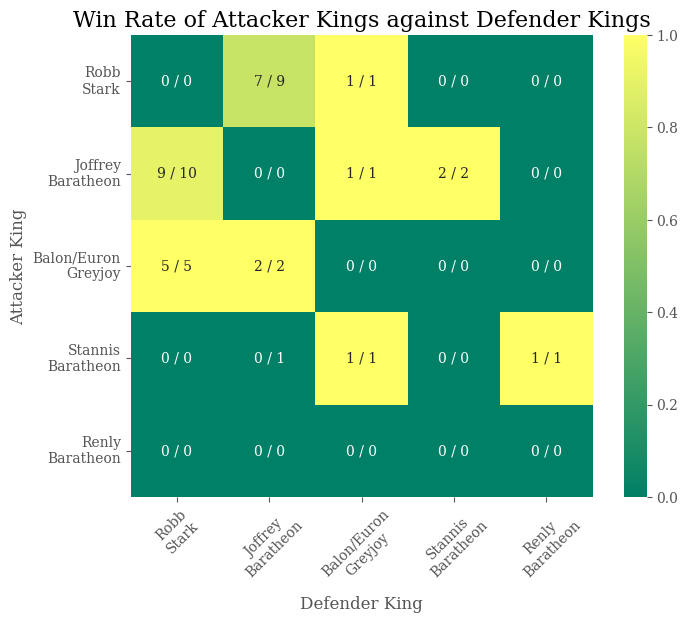
Robb Stark and Joffrey Baratheon have fought many battles, compared to the other kings. Interestingly enough, there is a trend among these rivals; the attacker tends to win. Besides the point that attackers usually have an advantage, it could also be a trait from storytelling. When we follow our good guys (Robb Stark), and they attack, we assume that they win. If, on the other hand, they get ambushed, we don’t really expect them to win.
The true king
In conclusion, analyzing the battles in the Game of Thrones world reveals intriguing insights into the power dynamics and strategies of its various kingdoms.
Throughout the war for the Iron Throne, alliances played a crucial role, with key houses forming strategic partnerships to boost their forces. However, betrayals and unexpected twists often shifted the balance of power, demonstrating the unpredictable nature of politics and warfare in the fictional world of Westeros.
While landmass and military might initially appeared to favor certain contenders, the outcome of battles often defied expectations. The ability to adapt tactics and exploit opportunities proved to be equally important as sheer numbers and resources.
Ultimately, the analysis highlights the complexity of the conflict and the factors that influenced its outcome. The study provides valuable insights into the dynamics of power and ambition in the Game of Thrones universe.
So who has proven themself worthy of the title as the greatest king of them all?
If we consider factors such as battle outcomes, strategic alliances, and overall impact on the conflict for the Iron Throne, Joffrey Baratheon emerges as a prominent contender for the title of the greatest king.
Joffrey effectively defended his territory and maintained alliances with powerful houses like the Lannisters and Tyrells. His ability to withstand attacks and maintain control over the Crownlands and King's Landing demonstrates a certain level of strategic prowess.
While other kings, such as Robb Stark and Stannis Baratheon, had their moments of success, their ultimate fates and the outcomes of their respective campaigns may diminish their claims to greatness in comparison to Joffrey. As the underdogs, the Greyjoys managed to cause much havoc, despite their size. But even the strongest navy-nation in Westeros still does not stand a chance against the huge armies on land.
However, it's important to note that greatness can be interpreted in various ways, and each king had their strengths and weaknesses. Ultimately, the determination of the greatest king may vary depending on individual perspectives and interpretations of the events in the Game of Thrones universe.
Sourcecode for website can be found on Marcrulo.github.io. Prevously assignments: Stealing in San Francisco.